Key takeaways
- AI startups building world models (which simulate physics, rather than generating text) are choosing AWS Trainium over other chips for training.
- Odyssey achieved 80% model flop utilization on Trainium, roughly double the industry average of 40-50%.
- AWS offers both Trainium and Nvidia GPUs, letting customers choose the best infrastructure for their workload.
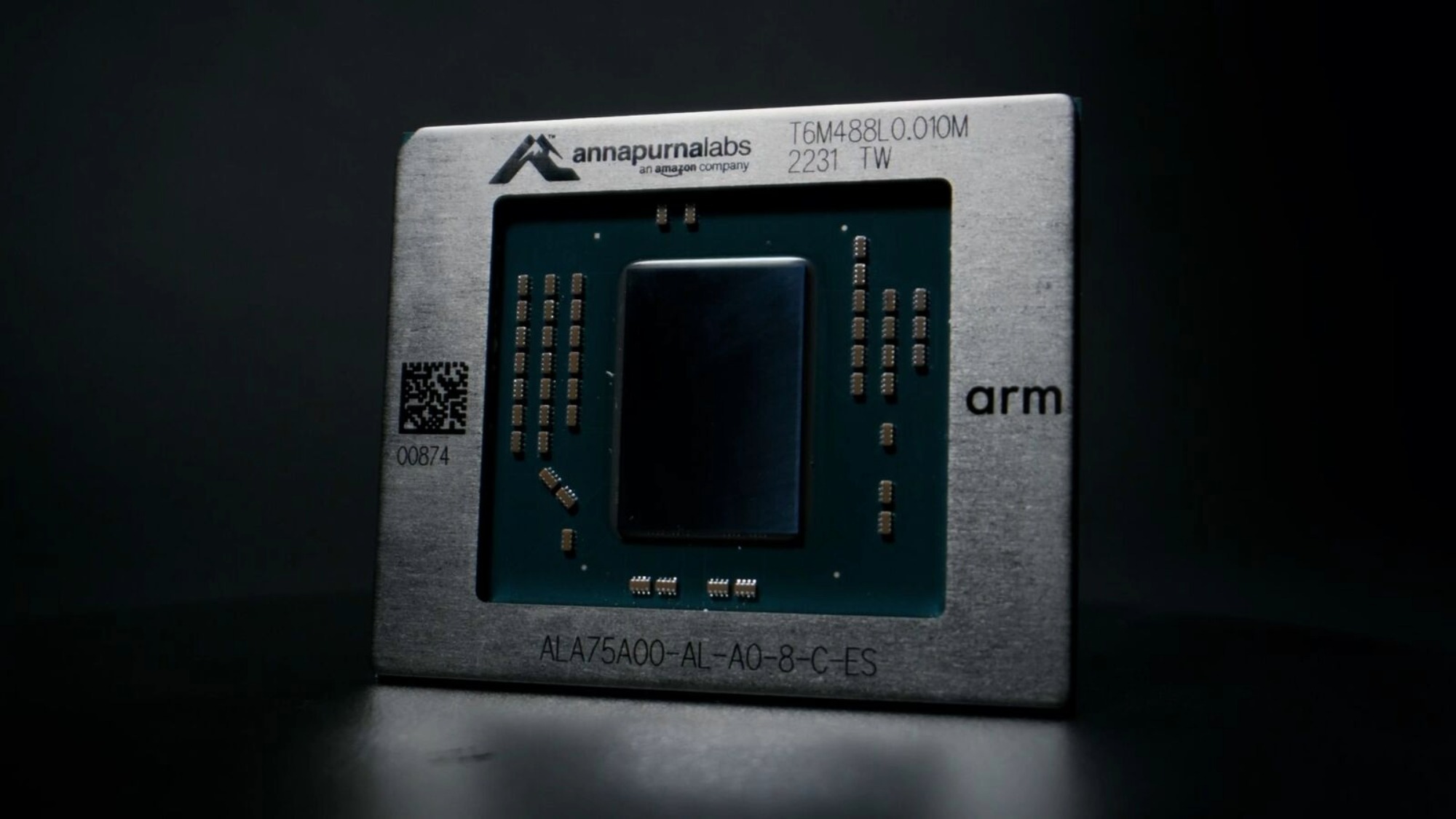
Some of the biggest names in AI are already building on Amazon’s AI chips. Anthropic trains and runs models on AWS Trainium chips, and OpenAI has committed to consume approximately 2 GW of future Trainium capacity as part of multi-year partnerships with Amazon. But a different kind of customer is emerging on the platform—one that reveals something about where AI is heading that the chatbot era alone can’t show.

A growing cohort of AI startups is choosing Trainium to train models that don’t generate text. They generate physics, environments, and interactive simulations of the real world. These are called world models, and they represent one of the most compute-intensive frontiers in AI.
What are world models and why do they need different infrastructure?
World models are AI systems trained to simulate how the physical world behaves. Rather than predicting the next word in a sentence, they predict the next frame of a scene—accounting for gravity, light, motion, and the interactions between objects. The applications range from robotics and autonomous vehicles to game engines and industrial simulation.
Training these models requires enormous, sustained compute. Unlike large language models, which can be trained in bursts, world models demand long, uninterrupted runs at high utilization—making the cost-per-useful-compute the defining metric for the companies building them.
How AI startup Odyssey achieved unprecedented compute efficiency on AWS Trainium
Odyssey, a startup building world models that simulate physics, recently achieved 80% model flop utilization (MFU) on Trainium3—a metric that measures how much of a chip’s theoretical peak performance is actually realized during a real workload.
In an industry where 40 to 50% MFU is considered well-optimized, 80% is exceptional. It means Odyssey extracts nearly twice the useful compute per dollar compared to typical infrastructure.
Ron Diamant—the vice president and distinguished engineer overseeing Amazon’s work on Trainium—called Odyssey’s team “very, very impressive,” noting their ability to optimize their world model on Trainium with minimal support from Amazon’s side. “They just went ahead and did it,” he said.
Why Amazon designed Trainium as a general-purpose AI accelerator
Trainium wasn’t built for a single model architecture. Amazon’s chip team studied a range of workloads—transformers, vision encoders, diffusion models, and world models—then generalized the underlying compute primitives into a flexible instruction set.
“We're not building a transformer or world-model accelerator, that's not our approach. We study these workloads, work backwards to the primitives required to run them fast, and then generalize an instruction set for general-purpose compute that still accelerates these workloads exceptionally well", said Diamant.
That design philosophy is paying off as new customers arrive with novel architectures. Each world model has slight deviations from the last, and Trainium’s generalized approach means startups can achieve high performance without extensive custom optimization.
“We're not building a transformer or world-model accelerator, that's not our approach. We study these workloads, work backwards to the primitives required to run them fast, and then generalize an instruction set for general-purpose compute that still accelerates these workloads exceptionally well.”
Ron Diamant
Vice President & Chief Architect, Trainium, AmazonWhy sustained AI chip performance matters
One of the less obvious advantages Diamant highlighted: Trainium can sustain 80% utilization over long training runs without overheating—a challenge that limits many competing chips.
Diamant explained that Amazon invests “across the stack, from the software to the thermal solution and the power delivery solution” to ensure Trainium can sustain high utilization over long inference or training runs, a challenge he says many competing chips can’t match.
For world model companies that need to scale compute to serve many customers cost-efficiently, this sustained performance translates directly to economics.

AWS offers Trainium alongside other chips, giving AI startups infrastructure choice
Odyssey isn’t alone. DeCart AI, another frontier AI lab training on Trainium, has publicly shared strong results for real-time generative video—achieving quadruple the performance of conventional chips. And the platform continues to attract startups across audio, vision, and other compute-intensive AI categories.
As part of its strategic partnership with AWS, Neura Robotics is using Trainium to advance physical AI. Splash Music reduced AI training costs by up to 50%, enabling music creation tools priced for independent artists. And Poolside, whose AI models write production software, powers inference through Trainium on Amazon Bedrock to deliver code generation at enterprise-viable economics.
Amazon's AI chip business continues to grow. AWS offers both Trainium and Nvidia GPUs, giving customers the broadest choice of infrastructure and silicon to fit their workloads. For the startups building beyond chatbots, that choice increasingly points to Amazon's AI chips.
Trending news and stories
- Investing more than $230 million in higher pay and expanded benefits for Whole Foods Market team members
- Millions of students can now get access to a free year of Kiro from AWS
- Amazon Leo adds 6 new Arianespace launches, expanding its launch partnership
- Amazon’s 2026 Top 100+ Toys list: Something for every kid at heart