
Key takeaways
- Amazon is engaging with world leaders on internet access, responsible AI, and sustainability.
- Amazon Leo has deployed nearly 400 satellites and signed new agreements to connect underserved communities.
- Amazon's data centers are seven times more water-efficient than the industry average.
I'm heading to New York for the 81st United Nations General Assembly (UNGA) to meet with world leaders, policymakers, and civil society. In my 26 years at Amazon, I've seen how long-term investment in people and technology creates shared value. It drives our work across connectivity, AI, and sustainability, and 2026 has been a year of tangible progress on all three.
Amazon Leo: From orbit to impact
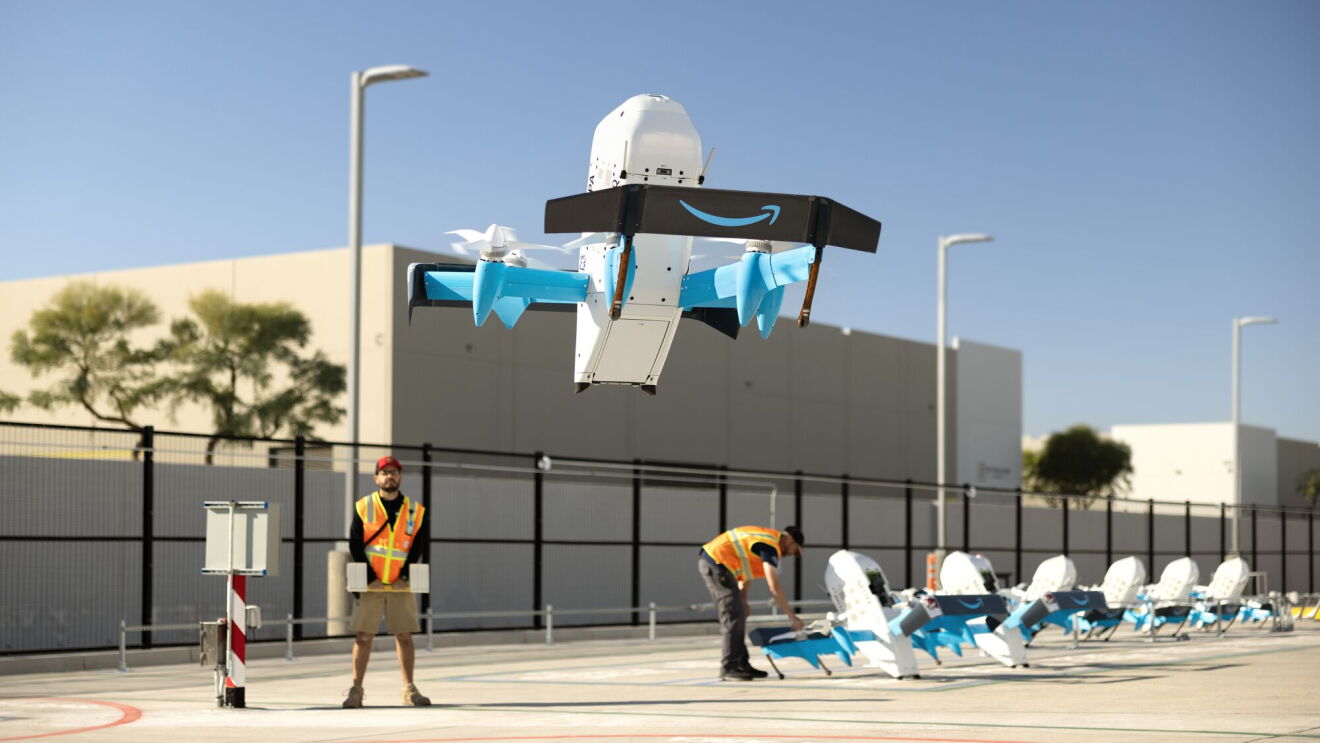
Amazon Leo began full-scale deployment of its satellite constellation in April 2025. We have completed 14 missions to date and have nearly 400 satellites in low Earth orbit, with more than 100 launches secured across four launch providers.
Our satellites will deliver fast, reliable internet for everyday use including video calls, telehealth, remote work, and online learning. Amazon Leo is designed to serve people, communities, businesses, governments, and other organizations that traditional infrastructure cannot reach affordably.
That vision is already taking shape through the customers and partners like Delta Air Lines, which will bring Leo-powered connectivity to its aircraft, and AT&T, the first major U.S. telecommunications provider to offer Amazon Leo's satellite broadband to its business customers. We've built a network of more than 20 partners working to extend our service around the world, from Herotel, which is bringing reliable internet to farms and rural communities across South Africa, to NBN Co in Australia and DIRECTV in Latin America.

And we're looking further ahead. Amazon Leo has filed with the Federal Communications Commission (FCC) to launch and operate more than 5,100 low Earth orbit satellites for a direct-to-device service including straight to mobile phones, with deployment expected to begin as early as 2028.
Connectivity is how people participate in the modern economy, access services, and build opportunity where none existed before. And this work contributes directly to the UN's Sustainable Development Goals for building resilient infrastructure and innovation that reaches all people, enabling connectivity that expands access to quality education in remote communities, and closing the digital divide that leaves billions without basic internet access. Amazon Leo's satellite constellation will help deliver on these goals in the places that need it most.
Responsible AI: Building tools that serve everyone
AI continues to develop at a remarkable pace. At Amazon, our approach remains grounded in a commitment to building AI that is responsible, inclusive, and designed to augment human potential—not replace it.
Through Amazon Bedrock and Amazon Bedrock Guardrails, we give customers the tools to build generative AI applications with built-in safety and governance features, including content filtering, automated reasoning checks grounded in mathematical logic, and data protections that let organizations maintain control over how their information is used.
As AI systems become more autonomous, we are extending those safeguards to agentic workflows. Earlier this year, we launched new capabilities that let organizations define clear boundaries for what AI agents can access and do, evaluate agent actions in real time, and block risks like prompt injection before they reach downstream systems.

We continue to advocate for risk-based regulatory frameworks that protect against actual harms while preserving the conditions for competition and innovation. We support the work of the U.S. Artificial Intelligence Safety Institute. We’ve also signed the Frontier AI Safety Commitments alongside 15 other companies at the Seoul Summit, and we continue to collaborate with governments and institutions around the world to develop interoperable standards.
Getting AI governance right requires ongoing cooperation between companies, governments, academia, and civil society. No single entity can solve these challenges alone.
Infrastructure: Building the compute the world needs, sustainably
AI requires infrastructure. We know that infrastructure can be built responsibly, because that’s what the data shows.
In 2025, Amazon added more data center capacity than any other company globally. Every facility is designed to deliver high performance with the lowest possible energy and water use.
On water, our data centers are over seven times more efficient than the industry average, using air cooling for most of the year and water only during the hottest days. We have achieved a 52% improvement in water efficiency since 2021. We are 75% of the way toward our goal of being water-positive by 2030, meaning we will return more clean water to communities than we use in operations.
Powering this infrastructure responsibly is just as important as building it efficiently. Our carbon-free energy portfolio now spans more than 712 projects across 30 countries, representing 42 gigawatts of capacity. And we are investing in the next generation of clean energy sources, including nuclear, advanced geothermal, and long-duration storage, to bring new carbon-free power to the grid.
Our commitment to The Climate Pledge, to be net-zero carbon by 2040, remains firm.
Looking ahead
At UNGA, the conversations will focus on what the global community can do together. For Amazon, the answer starts with sustained commitments, connecting communities that have been left behind, building AI tools and infrastructure that work for everyone, and protecting the planet we share.
I look forward to the discussions ahead.
Trending news and stories
- Amazon raises minimum starting pay for full-time core operations employees to $20/hour, with average pay reaching nearly $24/hour
- Amazon is giving every US employee a discount on groceries
- Prime Big Deal Days is back October 6-7: Here’s what to expect
- Prime Big Deal Days 2026: Early deals you can shop right now