
Key takeaways
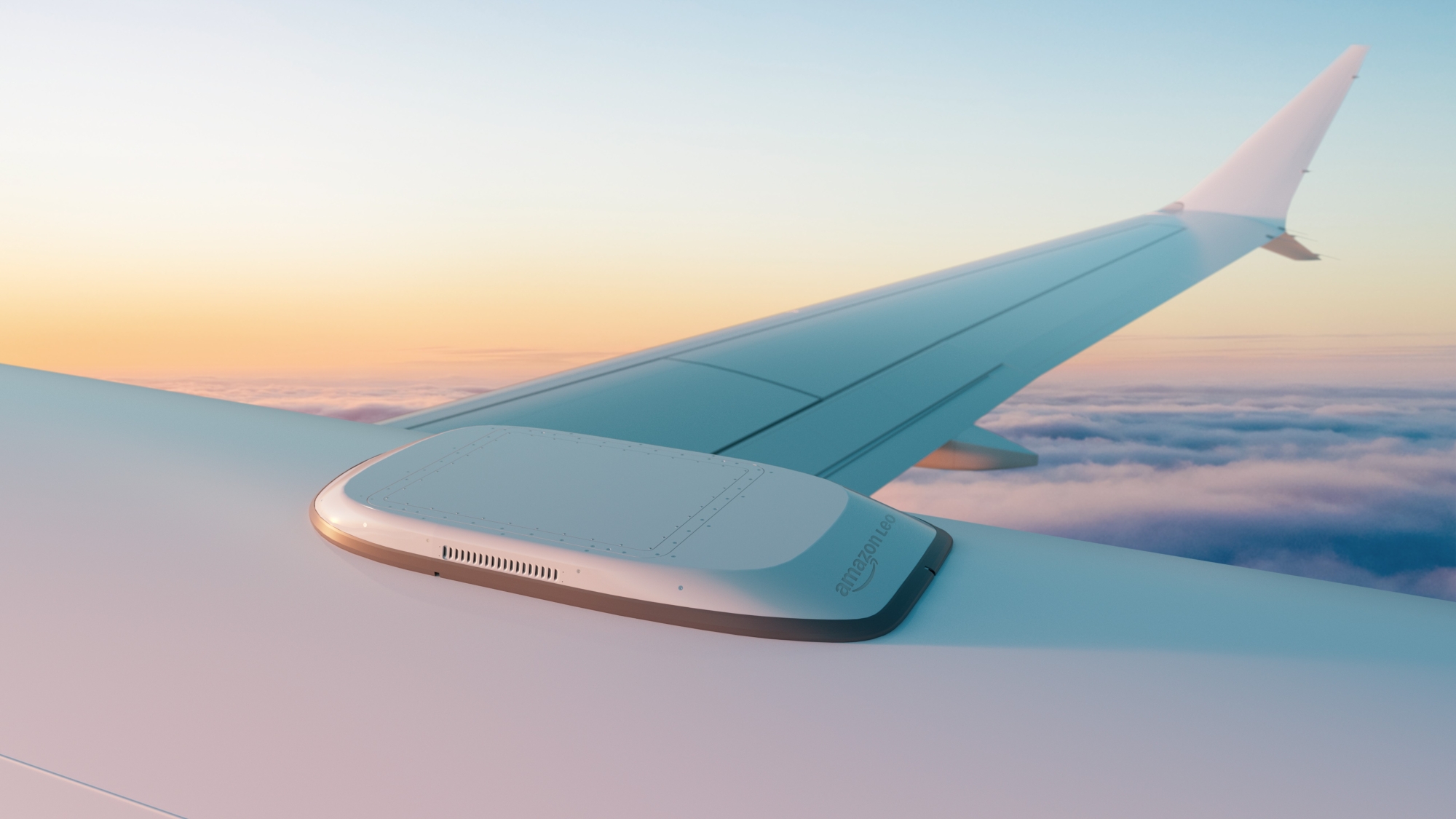
- The Amazon Leo Aviation Antenna is purpose-built to maximize performance and minimize maintenance.
- The full-duplex antenna delivers speeds of up to 1 Gbps down and 400 Mbps up simultaneously.
- A single antenna connects a full aircraft for entertainment, collaboration, and crew operations.
- The low-profile antenna has no moving parts, reducing maintenance, and can be installed in one day.
Amazon Leo is preparing to provide fast, reliable internet connectivity to a wide variety of customers, using satellites in low Earth orbit to deliver high speeds and low latency across land, sea, and skies. We design our hardware to optimize performance across the network, and our newest antenna, the Amazon Leo Aviation Antenna, will allow commercial airline passengers and crew to enjoy high performance from their departure gate all the way to their arrival gate.

A first-class connectivity experience in every seat

While the Amazon Leo Aviation Antenna has numerous design features to increase aircraft and airline operational efficiency, the most noticeable impact will be on passengers and crew connecting to the Amazon Leo network, whether that’s at cruising altitude or parked at the gate.
The antenna is appropriate for a range of aviation use cases, from wide-body commercial aircraft to regional jets. Its full-duplex phased array technology delivers simultaneous speeds of up to 1 gigabit per second (Gbps) download and 400 megabits per second (Mbps) upload while users are aboard the aircraft. A single Amazon Leo Aviation Antenna provides enough bandwidth for premium connectivity experiences across every seat class, while airline crew can use it to improve the passenger experience and operations using near-real-time information.
“Amazon Leo can connect a full plane of passengers and crew with speeds that handle any activity seamlessly, whether passengers want to game, watch a movie, listen to music, or collaborate with colleagues on a project,” said Trevor Vieweg, director of global business for Amazon Leo. “We expect our service to be so fast and reliable that passengers will seek out flights featuring Leo connectivity.”
Purpose-built for performance and simplicity

Although the Amazon Leo Aviation Antenna shares some of the same core technology that powers our Leo Ultra antenna, it needed to be purpose-built for the demands and stresses of aviation. That meant engineering an electronically steered antenna with no moving parts (to reduce maintenance downtime) and capable of withstanding harsh weather and temperature—to deliver reliable performance as aircraft traverse the globe.
Aviation customers will install the antenna on the exterior airframe, and the antenna will use aviation-grade connectors to link to aircraft power systems and communicate with interior systems. The antenna’s low profile—it measures 58 inches long, 30 inches wide, and 2.6 inches high (147 by 76 by 6.6 centimeters)—minimizes added aircraft drag and fuel consumption. Its simple design with an integrated modem and streamlined mounting allows for single-day installation.

Staying connected over oceans, polar routes, and remote areas
As aircraft fly overhead at 580 miles per hour (933 kilometers per hour), the antenna connects to our network by establishing a link to a passing Amazon Leo satellite in low Earth orbit. It then seamlessly hands off that link from one satellite to another as the aircraft and satellites move relative to each other. From there, the satellite communicates with our network of gateway antennas on the ground, each of which uses our global fiber network to reach the nearest AWS edge location and then onward to the internet, a customer’s resources on AWS or another cloud provider, or a customer’s private network.

Amazon Leo is building more than 300 ground gateways around the world to reduce network latency and enhance resilience. In-flight connectivity has historically degraded over oceans, polar routes, and remote places that are far from gateways, and in those areas, our satellites will use laser links to transmit data between each other and relay user data to and from the most logical nearby ground gateways.

Innovating with aviation customers
“We’ve thought through every aspect of aviation operations to build an antenna and a service that deliver performance, reliability, and efficiency—and that shows in the Amazon Leo Aviation Antenna and the industry’s response to our technology,” Vieweg said. “We’re thrilled to have agreements in place already with Delta and JetBlue based on the strength of our initial offering, and it’s only going to get better from here as we innovate together with our customers.”
We look forward to sharing more details of our in-flight connectivity solution in the coming months. Learn more about Amazon Leo's high-speed connectivity for aviation.
Trending news and stories
- The race our nation can’t afford to lose, plus a new commitment from us and a fresh set of community investments
- Introducing all-new Amazon Alexa Tablets—powerful tablets with Alexa+ built in
- Amazon's Holiday Kids Gift Book is back with 600+ toys, games, and gifts for every age
- Amazon introduces a completely redesigned Kindle family